
Bitcoin Explained: From Digital Money to Blockchain
Bitcoin explained simply: a peer-to-peer digital money secured by cryptography. Learn how transactions, mining and the blockchain work, and why it matters.
A small experiment that became a global money system
In October 2008, in the middle of the worst financial crisis in decades, an unknown author using the name Satoshi Nakamoto published a nine-page document to a cryptography mailing list. The title was modest: Bitcoin: A Peer-to-Peer Electronic Cash System. The idea inside was not.
Bitcoin, explained in one line, is digital money that works without a bank in the middle. There is no central company, no head office, no CEO. Instead, thousands of computers around the world agree on who owns what. Sixteen years later, that document has become a global network that anyone with an internet connection can use.
This article walks through how Bitcoin actually works, why the blockchain matters, and what beginners should understand before touching a single coin.
Concrete example
If you send USD 100 through a bank, the bank updates its own internal database and tells the recipient's bank to do the same. With Bitcoin, no bank does that. Instead, thousands of independent computers each keep a copy of the same ledger and verify the transaction together. The record is public, but the identities behind it are pseudonymous.
The challenge: money that needs trust
Every form of money requires trust. A banknote is trusted because a state guarantees it. A bank transfer is trusted because banks settle between themselves. A credit card payment is trusted because a payment processor stands behind it.
That system works well for billions of people, but it has a structural weakness: it depends on intermediaries. Intermediaries can fail, censor, reverse transactions, or charge fees. During the 2008 crisis, trust in those intermediaries dropped sharply, and Nakamoto's proposal addressed that directly.
The challenge was threefold:
- Double spending. Digital files can be copied. How do you stop someone spending the same digital coin twice without a central referee?
- Agreement without authority. How do thousands of anonymous participants agree on a single version of the truth?
- Incentives. Who pays for the computers, and why would they behave honestly?
Bitcoin's answer to all three is the same: a chain of blocks, validated by work, and rewarded with new coins.
The approach: how Bitcoin actually solves it
A public ledger, copied everywhere
Bitcoin's core innovation is not the coin. It is the ledger. Every transaction ever made is recorded in a public database called the blockchain, and every node (a computer running Bitcoin software) keeps its own copy. If one copy is altered, it is rejected by the rest of the network.
Blocks, hashes and proof of work
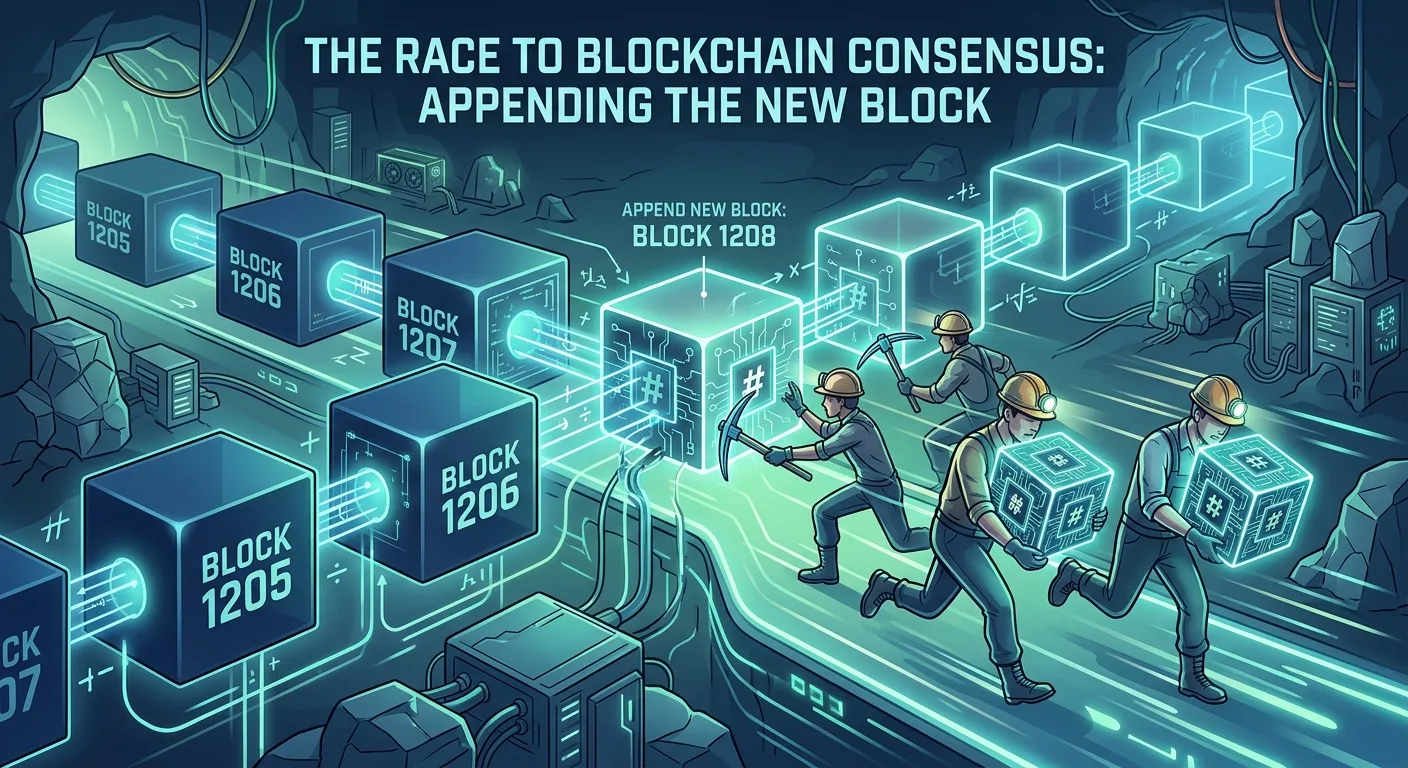
Transactions are grouped into blocks. Each block contains a cryptographic fingerprint (a hash) of the previous block, which is why tampering with an old block breaks every block after it. To add a new block, miners must find a hash below a target value, a task that requires real electricity and hardware.
This is proof of work. It is deliberately expensive, and that cost is what makes rewriting history impractical.
Block header (simplified)
-------------------------
previous_block_hash : 0000000000000000000a3f...
merkle_root         : 4f2c8e...   (fingerprint of all transactions)
timestamp           : 1735689600
nonce               : 3918451239  (miners change this until hash is valid)
Mining and the 21 million cap
Miners compete to find valid blocks. The winner receives newly created bitcoin plus transaction fees. This is how new coins enter circulation. The supply is capped at 21 million, and the reward halves roughly every four years, a mechanism called the halving.
By 2026, several halvings have already occurred, and the block subsidy is a fraction of what it once was. Fees now matter far more to miners than they did in the early years.
Concrete example
Imagine a miner in Kazakhstan and a miner in Texas both racing to solve the same block. The one who finds a valid hash first broadcasts the block. The other stops, accepts it, and starts on the next one. No voting, no meeting, no committee. The rule is simple: the longest valid chain wins.
Wallets, keys and the reality of ownership
A Bitcoin wallet does not store coins. It stores keys.
- A private key proves ownership and authorises spending. Lose it, and the funds are gone.
- A public key derives an address, which you share to receive funds.
A common beginner mistake is treating a wallet like a bank account. It is closer to a keychain. If you lose the key, there is no support line to call. This is why self-custody is powerful and unforgiving at the same time.
| Custody type | Who holds the keys | Convenience | Risk |
|---|---|---|---|
| Exchange account | The exchange | High | Counterparty failure, withdrawal freezes |
| Mobile wallet | You | Medium | Phone loss, malware |
| Hardware wallet | You | Lower | Seed phrase loss, physical damage |
You can inspect any transaction yourself on a public block explorer, which is a useful habit when learning. Beginners often start by reading the Bitcoin whitepaper and then exploring a block explorer to see a real transaction.
# Inspect a Bitcoin address balance using a public API (illustrative)
curl -s https://blockstream.info/api/address/bc1qexampleaddressxxxxxxxxxxxxxxxxxxxx
Concrete example
A user in Argentina buys a hardware wallet, writes the 12-word seed phrase on paper, and stores it in two separate physical locations. If their laptop is stolen, the attacker gains nothing. If their house burns down, the second copy still restores the wallet.
The results: what Bitcoin actually changed
Bitcoin did not replace banks. It did something subtler and more durable: it proved that a monetary system can run without a central operator.
Qualitative outcomes are easy to observe. An open-source network with no company behind it has run continuously since 2009. Transactions settle globally within minutes, without asking permission. A settlement layer exists that anyone can audit.
Quantitative claims require care. The number of active addresses, the hash rate, and the price fluctuate constantly and should be checked on live sources such as a block explorer or a market data aggregator, marked here as (to verify).
What is verifiable and stable:
- The supply cap of 21 million is enforced by the protocol.
- The block interval targets ten minutes on average.
- The halving schedule is written into the code.
Lessons learned
- The innovation is the ledger, not the price. Bitcoin's value proposition is decentralised settlement, not a ticker.
- Cost creates security. Proof of work is wasteful by design. That waste is what makes history hard to rewrite.
- Keys are responsibility. Self-custody removes counterparty risk and adds personal risk. Both are real.
- Volatility is a feature of a young asset. Prices swing violently because liquidity is thinner than in traditional markets.
- No one is in charge. That means no bailouts, no support tickets, and no one to blame.
How to replicate this approach
If you want to understand Bitcoin properly rather than just buy it, work through this checklist.
- Read the original whitepaper once, slowly.
- Install a small wallet and receive a tiny amount.
- Send a transaction and watch it confirm on a block explorer.
- Learn what a seed phrase is and write yours offline.
- Never share your private key or seed phrase with anyone, ever.
- Start with an amount you would not mind losing entirely.
- Ignore anyone promising guaranteed returns. They do not exist.
A clear-eyed conclusion
Bitcoin is neither a magic money printer nor a scam. It is an experiment in decentralised coordination that has survived for over fifteen years. It has real limitations: slow throughput compared to centralised payment rails, high volatility, and a steep learning curve for beginners. It also has real properties: censorship resistance, a fixed supply, and a public ledger anyone can verify.
The honest way to learn Bitcoin is to use small amounts, read the code and the data, and stay sceptical of anyone selling certainty. The technology is remarkable. The hype is not.
FAQ
Is Bitcoin anonymous?
No. It is pseudonymous. Every transaction is permanently recorded on a public ledger, and chain analysis firms can link addresses to identities in many cases. Using Bitcoin for illegal activity is a common misconception; the ledger is far more traceable than cash.
Can Bitcoin be hacked?
The core protocol has never been successfully broken. Attacks tend to target the edges: exchanges, wallets, and users who leak their keys. Most losses come from phishing, malware, or lost seed phrases, not from breaking Bitcoin itself.
Should beginners buy Bitcoin?
That is a personal decision, not a recommendation. What matters is understanding the asset first, using only money you can afford to lose, and avoiding leverage. Nobody credible can promise you a return, and anyone who does should be treated with suspicion.
Comments (0)