
Blockchain vs Bitcoin: Key Differences Explained
Blockchain is the technology; Bitcoin is one application of it. We break down the blockchain vs bitcoin distinction, with clear examples and a practical verdict.
Blockchain is the technology; Bitcoin is one application built on it. Think of the blockchain as a public, shared database that no single party controls, and Bitcoin as the first and most famous product running on that database. Confusing the two is like saying "the internet" when you mean "email" — related, but not the same thing.
That distinction matters more in 2026 than ever, because blockchains now power stablecoins, tokenised funds and supply-chain records, while Bitcoin has settled into a role closer to "digital gold". If you are trying to understand crypto, this is the first fork in the road.
This guide separates the two cleanly: what each one is, where each excels, and which one you actually care about depending on your goal.
Blockchain vs Bitcoin at a glance
| Criterion | Blockchain (the technology) | Bitcoin (the application) |
|---|---|---|
| What it is | A distributed ledger secured by cryptography and consensus | A cryptocurrency and payment network running on its own blockchain |
| Scope | General-purpose infrastructure | A single, narrowly focused monetary system |
| Created | Concept formalised in 2008 (Bitcoin whitepaper) | Launched January 2009 |
| Governance | Varies: foundations, DAOs, companies, open communities | Informal, rough consensus among node operators, miners and developers |
| Programmability | High on general chains (smart contracts) | Deliberately limited scripting |
| Supply | Not applicable — no native token required | Capped at 21 million BTC by protocol |
| Typical use | Supply chains, identity, tokenisation, DeFi, voting | Store of value, settlement, cross-border transfers |
| Main trade-off | Complexity, governance, security varies by design | Slow throughput, limited flexibility |
Concrete example
When you send BTC, you are using one specific blockchain — Bitcoin's — for one specific purpose: transferring a scarce digital asset. When a logistics firm records a coffee shipment on a permissioned chain, no bitcoin is involved at all. Same underlying idea, two completely different jobs.
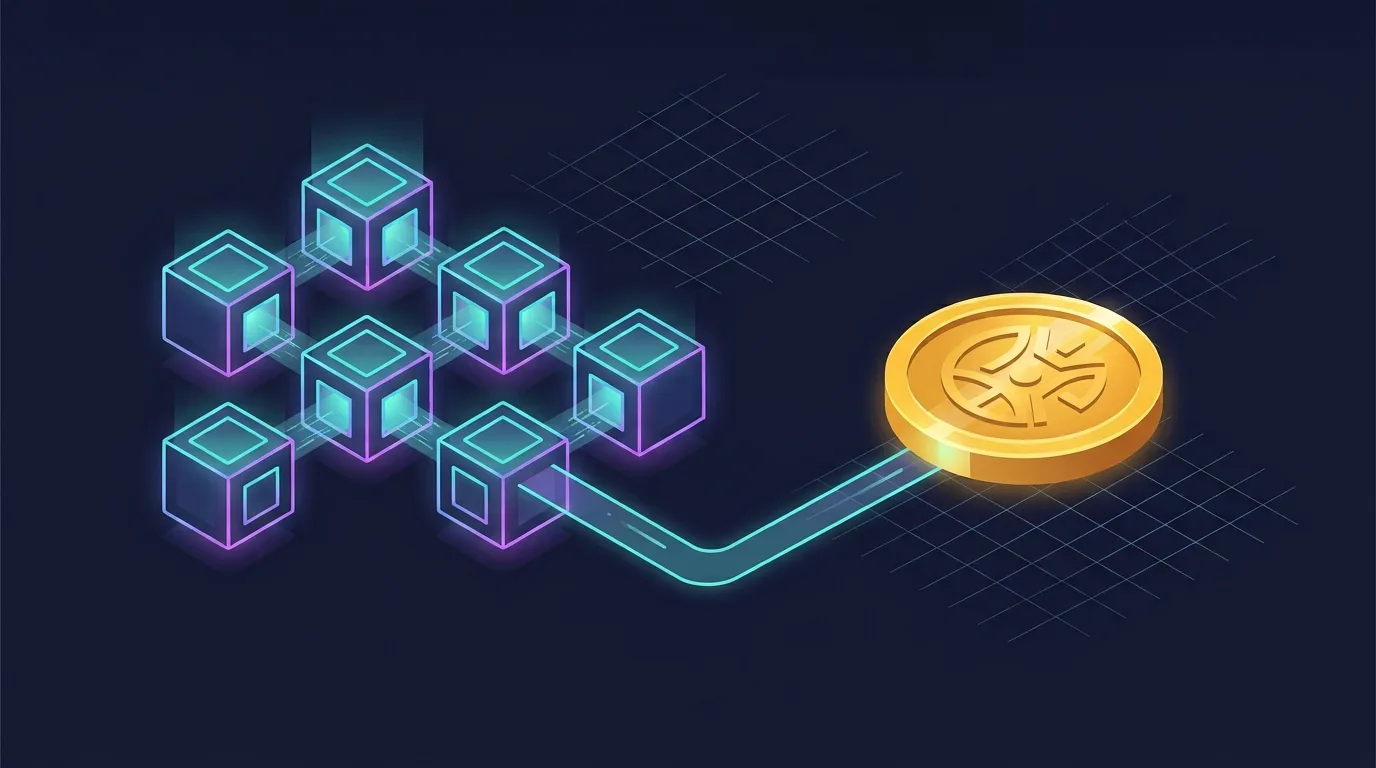
 Caption: Bitcoin is one branch of a much larger blockchain family tree, not the whole tree.
Option A: Blockchain, the technology
Overview
A blockchain is a ledger replicated across many computers, where transactions are grouped into blocks, cryptographically linked to the previous block, and validated by a consensus rule. Change one past block and every subsequent hash breaks — which is why tampering is expensive.
Crucially, a blockchain does not require a cryptocurrency. Permissioned chains used by enterprises often have no tradable token at all. The technology is a way to agree on a shared truth without a central referee.
Strengths
- Versatility. The same primitive supports payments, tokenised assets, identity and audit trails.
- Transparency or privacy, by design. Public chains are readable by anyone; permissioned chains restrict who can read or write.
- Composability. On general-purpose chains, smart contracts can call each other, letting developers build on existing code.
- Resilience. Replication means no single point of failure.
Weaknesses
- Complexity. Consensus, gas fees and key management are genuine barriers for newcomers.
- Governance friction. Upgrading a decentralised network is slow and political.
- Not always the right tool. For a private database with one trusted operator, a blockchain adds cost without adding trust.
Ideal use case
Anywhere multiple parties who do not fully trust each other need a shared, tamper-evident record: cross-border settlement, provenance tracking, tokenised securities, or decentralised finance.
Here is a minimal illustration of what "shared state" looks like in code:
// Illustrative only - a tiny on-chain counter contract
// SPDX-License-Identifier: MIT
pragma solidity ^0.8.20;

contract Counter {
    uint256 public count; // state stored on the blockchain

    function increment() external {
        count += 1; // every node will agree on this new value
    }
}
Option B: Bitcoin, the application
Overview
Bitcoin is a peer-to-peer electronic cash system described in a 2008 whitepaper attributed to Satoshi Nakamoto and launched in 2009. It runs on its own blockchain, uses proof-of-work mining to secure it, and issues new coins on a schedule that halves roughly every four years.
The design is intentionally conservative. Bitcoin's scripting language is limited compared with general-purpose chains, and its community has historically resisted changes that could compromise predictability. Supply is capped at 21 million BTC.
Strengths
- Predictable monetary policy. The issuance schedule is fixed in code and widely known.
- Longest track record. No other crypto network has run continuously for as long, which matters for trust.
- Deep liquidity. BTC is the most traded crypto asset and the reference point for the whole market.
- Simplicity. One asset, one purpose — easier to reason about than a general-purpose platform.
Weaknesses
- Limited throughput. Base-layer transactions are slow and can be costly during congestion; second layers help but add complexity.
- Little programmability. You cannot easily build a lending protocol directly on Bitcoin's base layer.
- Volatility. Price swings remain large compared with fiat currencies (to verify).
- Energy use. Proof-of-work consumes significant electricity, a recurring criticism.
Ideal use case
Long-horizon savings, censorship-resistant settlement and cross-border transfers where the recipient wants a scarce, liquid, widely recognised asset.
A quick way to inspect a real Bitcoin transaction without trusting any website:
# Query a Bitcoin node's view of the mempool (illustrative)
bitcoin-cli getmempoolinfo

# Check the current block height
bitcoin-cli getblockcount
Concrete example
A freelancer in Argentina invoices a client in Europe. She requests payment in BTC to avoid multiple currency conversions. The client sends the funds; the transaction is broadcast, included in a block and confirmed. No bank sits in the middle — but she still carries the price risk until she converts.
Selection criteria: how to tell them apart in practice
When people ask about blockchain vs bitcoin, they usually mean one of four things. Here is how to map the question to the right criterion.
- Purpose. Are you asking about infrastructure (how shared records work) or about an asset (what BTC is worth and does)? Infrastructure questions are about blockchain; asset questions are about Bitcoin.
- Scope. Blockchain is a category with hundreds of implementations. Bitcoin is one of them.
- Governance. General chains are steered by foundations, companies or DAOs. Bitcoin is steered by rough consensus — slower, but harder to capture.
- Risk profile. Building on a general chain exposes you to smart-contract bugs and governance shifts. Holding BTC exposes you mainly to market and custody risk.
A useful mental formula:
[ \text{Bitcoin} \subset \text{Blockchains} ]
In words: every Bitcoin is a blockchain, but not every blockchain is Bitcoin.
Concrete example
A company wants to issue a tokenised bond. It needs programmability and compliance controls — so it picks a general-purpose or permissioned chain, not Bitcoin. A treasury team wants a scarce, liquid reserve asset — it looks at BTC. Different criteria, different answers.
Verdict
There is no winner here, because the two are not competing for the same job.
- Choose blockchain (as a technology) if… you need a shared, tamper-evident record between parties who do not fully trust each other, or you want to build applications on programmable infrastructure.
- Choose Bitcoin (as an asset) if… you want exposure to a scarce, liquid, long-running monetary network and can tolerate volatility and custody responsibility.
- Avoid both if… a single trusted operator with a normal database already solves your problem. Adding a blockchain there is usually cost without benefit.
Conclusion
The blockchain vs bitcoin confusion is really a category error: one is a tool, the other is a product made with that tool. Blockchain is the general-purpose ledger technology; Bitcoin is a specific, deliberately narrow monetary application of it. Once you hold that distinction, most crypto conversations become far easier to follow — and far harder to be misled by.
FAQ
Is Bitcoin a blockchain?
Yes. Bitcoin runs on its own blockchain, secured by proof-of-work. But "blockchain" is the broader category: many other chains exist, with different rules and purposes.
Can a blockchain exist without a cryptocurrency?
Yes. Permissioned or enterprise blockchains often have no tradable token. The token is a design choice, not a requirement of the technology.
Is Bitcoin the only cryptocurrency?
No. Thousands of cryptocurrencies exist, and BTC is one of them. It is the oldest and most liquid, but not the only one.
Should beginners learn blockchain or Bitcoin first?
Start with Bitcoin. Its rules are simpler and its history is longer, which makes it a good foundation before exploring programmable chains and DeFi.
Comments (0)