
Cross-Chain Technology: How Blockchains Talk to Each Other

Cross-chain technology lets separate blockchains exchange data and value. We break down bridges, messaging layers and the real risks behind blockchain interoperability.
Cross-chain technology is the set of protocols that lets separate blockchains exchange data, tokens and messages without a central intermediary. In practice, it is what allows a user to hold assets on one chain and use them on another — and it is also one of the most attacked surfaces in crypto.
Every blockchain is deliberately isolated. A Bitcoin node does not read Ethereum's state, and an Ethereum smart contract cannot natively verify a Solana transaction. That isolation is a feature: it keeps consensus simple and secure. But it creates a problem the moment users want to move value across networks. Blockchain interoperability is the answer — and the source of most of the risk.
The challenge: blockchains are islands

A blockchain is a self-contained state machine. Its nodes only validate what happens inside its own rules. If you understand how blockchain nodes keep a network decentralised, you already see the constraint: no node on chain A has any authority over chain B, and neither can read the other's mempool.
So "sending" a token from one chain to another is a misnomer. Nothing actually travels. What happens is that an asset is locked, burned or attested on the source chain, and a representation is created on the destination chain. The two ledgers must be kept in sync by something outside both of them.
That "something" is the hard part. The two chains cannot verify each other's consensus, so a bridge must introduce a third party — a set of validators, an oracle, a light client or a multisig — and every design choice trades trust for speed or cost.
Concrete example
When you bridge USDC from Ethereum to an L2, no dollars move. A contract locks or burns USDC on Ethereum, and an equal amount is minted or released on the destination. If the bridge's attestation layer is compromised, the destination chain has no way to know the backing is gone — it simply trusts the messenger.
The approach: how cross-chain communication works
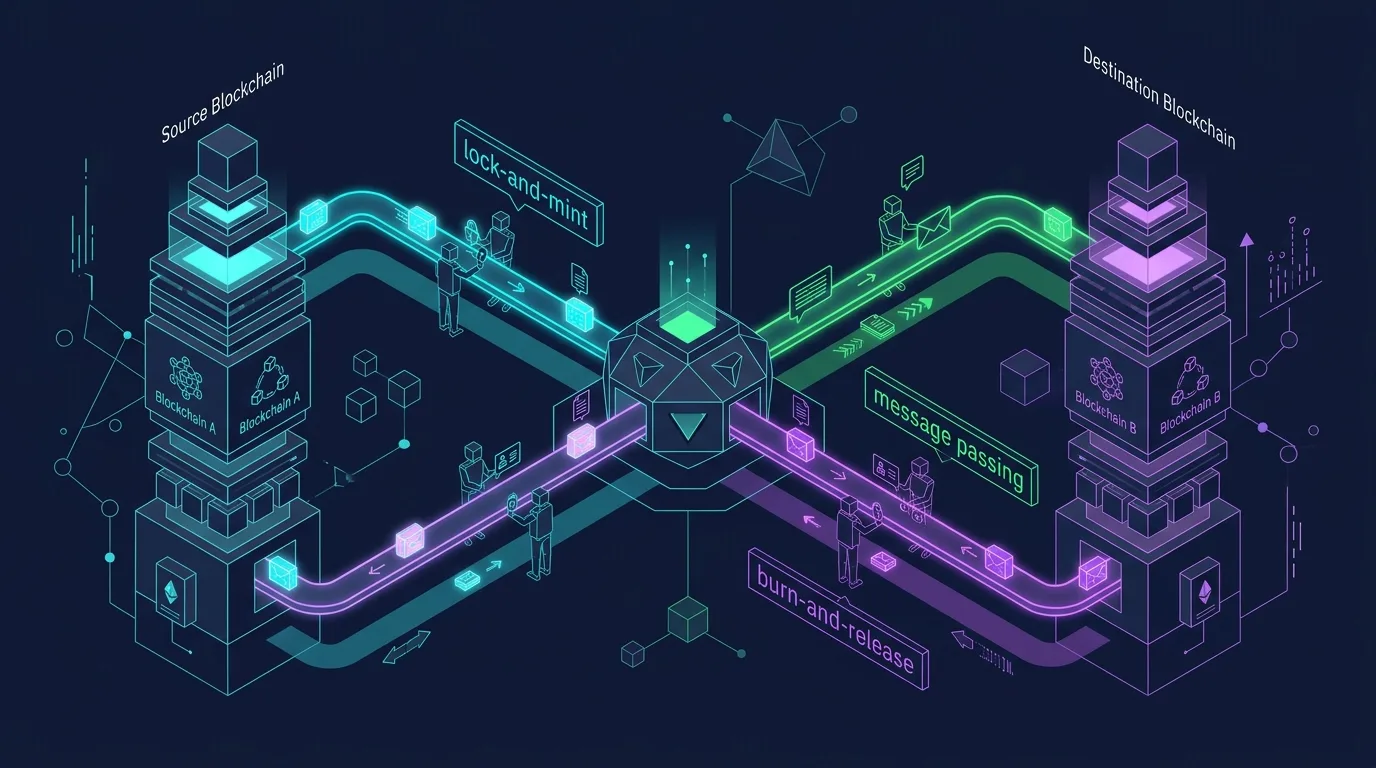
The industry has converged on a handful of patterns. They differ mainly in who attests that something happened on the source chain.
| Pattern | How it works | Trust assumption | Typical use |
|---|---|---|---|
| Lock-and-mint | Asset locked on source, wrapped token minted on destination | Bridge validators or multisig | Wrapped BTC on EVM chains |
| Burn-and-release | Native asset burned on source, released from a pool on destination | Liquidity pool + attestation | USDC via native issuance |
| Atomic swap | Hash time-locked contracts (HTLC) release both legs or neither | No intermediary; both parties | Peer-to-peer swaps |
| Light client / rollup bridge | Destination verifies source headers and proofs | Cryptographic, but expensive | L2 ↔ L1 messaging |
| General message passing | Arbitrary payloads relayed and executed | Varies: oracle, committee or light client | Cross-chain apps, governance |
The light-client approach is the most trust-minimised: the destination contract verifies the source chain's consensus proofs directly. It is how optimistic rollups settle to Ethereum. The catch is cost — verifying signatures for every block is heavy, so many general-purpose bridges fall back to committees or oracles.
Atomic swaps avoid an intermediary entirely using hash time-locked contracts. The logic is small and worth reading:
// Illustrative HTLC leg: funds are claimable with the secret, refundable after timeout
function claim(bytes32 secret) external {
    require(keccak256(abi.encodePacked(secret)) == hashLock, "bad secret");
    require(block.timestamp < expiry, "expired");
    payable(msg.sender).transfer(amount);
}

function refund() external {
    require(block.timestamp >= expiry, "not expired");
    payable(sender).transfer(amount);
}
For applications that need to react to events on another chain, the message-passing pattern is the standard. A contract emits an event; an off-chain relayer observes it, waits for finality, and calls a receiving contract on the destination chain:
// Illustrative relayer loop (pseudo-real, not production-ready)
const receipt = await source.provider.waitForTransaction(txHash, 1);
const event = source.interface.parseLog(receipt.logs[0]);

// Wait for the source chain to reach finality before acting
await waitForFinality(receipt.blockNumber);

await destination.sendMessage(
  event.args.recipient,
  event.args.payload,
  { gasLimit: 300000 }
);
Notice the finality wait. Skipping it is a classic bug: a relayer that acts on a block that is later reorganised can double-spend a bridged asset. The security of the whole path depends on the weakest link — the attestation layer, not the smart contract. That is why understanding blockchain consensus mechanisms matters even when you never touch a bridge directly.
Concrete example
A cross-chain governance vote: a DAO on chain A wants to execute a treasury action on chain B. It emits a proposal result, a relayer passes the payload, and a timelock on chain B executes it after a delay. If the relayer lies, the timelock gives users time to react — a deliberate design trade-off between speed and safety.
The results: what interoperability changed

Interoperability has quietly reshaped how users interact with crypto. Liquidity is no longer trapped on one chain: stablecoins circulate across L2s, DEX aggregators route orders across networks, and a single wallet can hold assets on a dozen chains. The user experience has improved — but the security surface has grown enormously.
Bridges became a top target precisely because they concentrate value and rely on a small set of signers. The pattern is consistent across major incidents: a compromised validator set, a key leak, or a faulty verification logic lets an attacker mint unbacked assets on the destination chain. The exact figures change and are disputed (to verify), but the lesson is stable — bridges are a single point of failure by design.
That is why the most durable trend in cross-chain technology is trust minimisation: more light clients, more cryptographic proofs, fewer trusted committees. Rollups settling to a shared layer are, in effect, a bridge built into the protocol. If you want the mental model behind that shared trust, the course on how blockchain really works covers the primitives that every bridge relies on.
Concrete example
A user who wants to move stablecoins across chains now has a choice: a fast third-party bridge with a committee (cheap, but trusts signers) or a slower canonical rollup bridge (slower, but cryptographically verified). The right answer depends on the amount and the risk tolerance — not on which bridge has the best marketing.
Lessons learned
- A bridge inherits the trust of its weakest component. A perfectly audited contract with a 3-of-5 multisig is only as safe as those five keys.
- Finality waits are not optional. Acting before the source chain is final is how relayers get exploited.
- Wrapped assets are claims, not the asset. They can be unbacked if the bridge breaks.
- Canonical bridges are usually safer than third-party ones for large amounts. Fewer trusted parties.
- Interoperability is a spectrum, not a binary. Atomic swaps, light clients and committees all sit on different points of the trust curve.
How to replicate this approach
- [ ] Identify whether you need asset transfer or arbitrary message passing — they have different trust models.
- [ ] For asset moves, compare canonical vs third-party bridges on trust assumptions, not just fees.
- [ ] Check whether the bridge verifies source-chain finality and how long it waits.
- [ ] Prefer light-client or rollup-native paths for large values.
- [ ] For message passing, add a timelock on the destination so users can react.
- [ ] Read the bridge's validator set and upgrade controls before depositing.
- [ ] Test on a small amount first; bridges fail loudly and expensively.
- [ ] Keep a mental model of how a transaction moves from wallet to confirmation — bridging is that journey, doubled.
Conclusion
Cross-chain technology is genuinely useful and genuinely dangerous. It solves a real problem — blockchains are isolated by design — but every bridge reintroduces a point of trust that the chains themselves were built to avoid. The honest position is not "bridges are safe" or "bridges are scams". It is that bridges are infrastructure, and infrastructure must be evaluated on its trust assumptions, not its interface. Treat a bridge like a bank transfer, not like a wallet: check who is attesting, how much is at stake, and whether the destination can verify the source.
FAQ
What is the difference between a bridge and cross-chain messaging?
A bridge moves assets between chains, usually by locking on one side and minting on the other. Cross-chain messaging passes arbitrary data or instructions — a governance vote, an oracle update, a function call — and is a more general primitive that asset bridges often use internally.
Are cross-chain bridges safe?
No bridge is risk-free. The safety depends on its attestation model: light-client bridges rely on cryptography, while committee-based bridges rely on a set of signers. Bridges have been repeatedly exploited, so treat them as high-risk infrastructure and never move more than you can afford to lose.
What is an atomic swap?
An atomic swap uses hash time-locked contracts so that two parties exchange assets across chains without an intermediary: either both legs complete or both are refunded after a timeout. It is trust-minimised but limited to what both chains can express — typically simple asset swaps, not complex logic.
- Blockchain vs Bitcoin: Key Differences Explained
- Blockchain Transactions Explained: From Wallet to Confirmation
- Decentralization Blockchain: The Core Idea Behind Web3
- Blockchain Nodes: How the Network Stays Decentralized
- Blockchain Consensus Mechanisms Explained: PoW, PoS and Beyond
- Blockchain for Beginners: How Blockchain Really Works
- Blockchain Fundamentals
Comments (0)