
Cryptocurrency development: build a coin from scratch

A hands-on case study of cryptocurrency development: how a small team shipped an educational proof-of-work chain, what broke, and where an educational blockchain must stop and a production system begins.
Cryptocurrency development is the discipline of designing, coding and testing a distributed ledger that issues and moves digital value. This case study follows a small team that built an educational proof-of-work chain from scratch — and explains exactly where such a project must stop and a production system must begin.
No token sale, no mainnet, no promises. Just code, consensus and hard lessons from the trenches. If you are moving from tutorials to real architecture, this is the path most teams actually walk.
The challenge: a chain with no shortcuts

A three-person team — one backend engineer, one cryptography enthusiast and one technical writer — decided to build a working cryptocurrency in eight weeks. The goal was not to launch a valuable asset. It was to understand, by building, why Bitcoin and Ethereum are shaped the way they are.
The constraints were severe and deliberate:
- No forks of existing codebases. Forking Bitcoin Core teaches you how to compile, not how consensus works.
- Proof of work, not proof of stake. PoW is simpler to reason about for a first chain: no validator set, no slashing, no finality gadget.
- A public testnet with at least ten independent nodes. A chain that runs on one laptop proves nothing.
- Zero financial claims. The coin was to be called a test asset and never sold.
The biggest early trap was scope. Most hobby chains die because their authors try to ship a virtual machine, a wallet, a block explorer and a mining pool in the first month. This team cut the scope to the bone: a ledger, a mempool, a simple RPC interface and a CLI wallet.
Concrete example
Every real chain has to answer the same question: how do you stop someone from rewriting history? In Bitcoin, the answer is cumulative proof of work — the longest chain wins. In this project, the team implemented the same rule in under 40 lines of Python, which made the trade-off immediately visible: chain reorganisation is not a bug, it is the mechanism.
 Every design decision in a new chain is a fork in the road.
Before writing consensus code, the team spent a week on foundations. The article on blockchain architecture and how nodes, blocks and consensus fit together became their shared reference, and the Blockchain Fundamentals course covering transactions, Merkle trees and consensus filled the gaps faster than any blog post.
The approach: small, verifiable steps

The build was split into six layers, each testable on its own. This is the part most tutorials skip — and the part that separates a working chain from a demo.
| Layer | What it does | Simplification made | Production concern skipped |
|---|---|---|---|
| Block structure | Header, transactions, timestamp | Fixed block size, no SegWit-style malleability fixes | Block propagation and relay policy |
| Hashing | SHA-256 over the header | Single hash function | ASIC resistance, difficulty adjustment tuning |
| Signatures | ECDSA over secp256k1 | One library, no hardware wallets | Key management, multi-sig, address formats |
| Mempool | Ordered pending transactions | FIFO queue, no fee market | Fee estimation, RBF, package relay |
| Consensus | Longest-chain rule | No checkpointing | Selfish mining, eclipse attacks |
| Networking | Gossip over TCP | No encryption | Peer discovery, DoS protection |
Each layer got a test suite before the next one started. The block header, for instance, was defined as a fixed byte layout so that hashing stayed deterministic across languages:
# Minimal block header: illustrative only, not production-ready
import hashlib, struct

def hash_header(version: int, prev_hash: bytes, merkle_root: bytes,
                timestamp: int, bits: int, nonce: int) -> bytes:
    # Fixed 80-byte layout, mirroring the Bitcoin header size
    raw = struct.pack("<I", version) + prev_hash + merkle_root \
          + struct.pack("<III", timestamp, bits, nonce)
    return hashlib.sha256(hashlib.sha256(raw).digest()).digest()

def mine(header_args, target: int) -> int:
    # Increment nonce until the hash falls below the target
    version, prev, root, ts, bits = header_args
    nonce = 0
    while int.from_bytes(hash_header(version, prev, root, ts, bits, nonce), "big") >= target:
        nonce += 1
    return nonce
The difficulty target follows the familiar rule: a hash is valid if its integer value is below a threshold. Formally, the expected number of attempts to find a valid nonce is
[ E[\text{attempts}] = \frac{2^{256}}{\text{target} + 1} ]
which is why "bits" in the header is enough to encode the entire mining difficulty. Getting this wrong — for example, using the wrong byte order — is the single most common reason a new chain forks itself on day one.
The second major decision was to ship a testnet with ten nodes before touching wallets. The team used containerised nodes on cheap VPS instances, with a simple script to restart and resync. That decision paid off immediately: three nodes disagreed on the genesis block because of a timestamp encoding bug.
Concrete example
When the first mined block was rejected by four of ten nodes, the bug was not in mining. It was in the merkle root computation: transactions were hashed in insertion order instead of being sorted, so two nodes that received the same transactions in a different order produced different roots. Fixing it took one line — and taught the team more about determinism than any lecture.
For the cryptography layer, the team leaned on the Understanding Cryptography course on hashing, keys and signatures, which covers exactly the primitives that a from-scratch chain needs. Signature verification, in particular, was kept deliberately boring:
// Illustrative ECDSA verification with the secp256k1 curve
import { secp256k1 } from "@noble/curves/secp256k1";
import { sha256 } from "@noble/hashes/sha256";

export function verifyTx(tx, publicKeyHex) {
  // Hash the canonical serialisation of the transaction body
  const digest = sha256(tx.canonicalBytes());
  const sig = secp256k1.Signature.fromCompact(tx.signature);
  return secp256k1.verify(sig, digest, publicKeyHex); // true or false, nothing else
}
Build one verifiable layer at a time, then test it in public.
One more rule saved months: every RPC call returned the raw transaction bytes alongside the parsed JSON. When a wallet showed a different balance than the node, the team could diff the bytes instead of guessing. That habit — always expose the primitive — is worth copying into any blockchain programming project.
The results: what actually changed
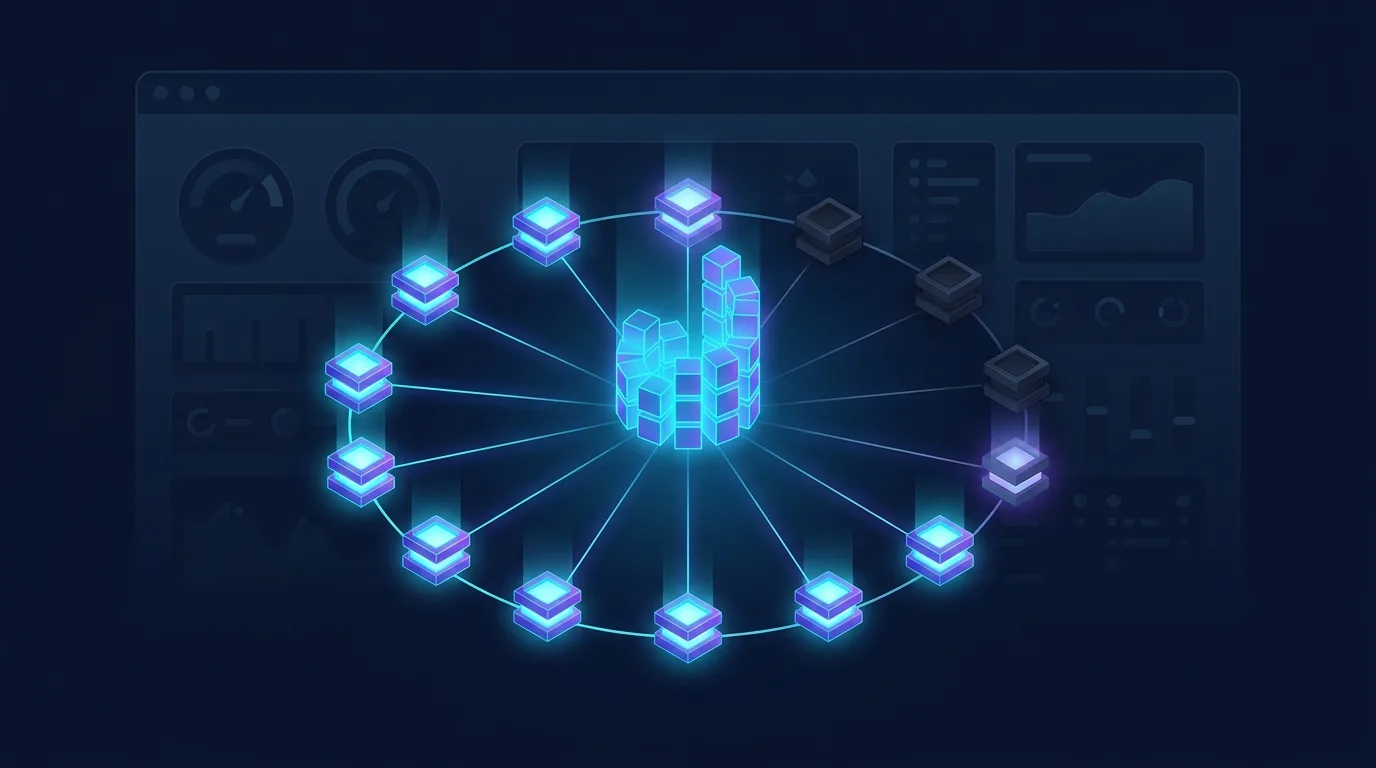
Eight weeks later, the testnet had been running for nineteen days with an average of nine active nodes. No token had been sold. No mainnet existed. And the team had learned more than in the previous year of reading.
The qualitative outcomes were clear:
- Consensus bugs surfaced fast. Three chain reorganisations occurred, all expected, all handled by the longest-chain rule.
- The mempool became the bottleneck. Under a burst of test transactions, a FIFO queue with no fee market stalled for minutes. That single observation explained, better than any article, why Bitcoin introduced fee-based prioritisation.
- Wallet UX was the hardest part. Key storage, address display and confirmation feedback consumed more time than the consensus code.
- The chain was not secure, and the team knew it. With nine nodes on three providers, a determined attacker could have partitioned the network trivially.
That last point is the dividing line the whole project was built around. An educational blockchain is a teaching instrument. A production system is a security and economic commitment — and the gap between the two is measured in years, audits and adversarial pressure.
| Dimension | Educational chain | Production system |
|---|---|---|
| Node count | 5–20, often one operator | Hundreds to thousands, independent |
| Audit | Peer review | Multiple external audits |
| Key management | CLI wallet, plaintext keys | HSM, multi-sig, hardware wallets |
| Upgrade path | Hard fork, no coordination | Governance, signalling, replay protection |
| Economic design | None | Emission, incentives, game theory |
| Legal exposure | Educational disclaimer | Securities, AML, tax |
Concrete example
Ethereum's 2016 hard fork after the DAO exploit is the clearest illustration of the gap. The code change itself was small; the social coordination — convincing miners, exchanges and users to follow one chain — was the real work. A hobby chain never faces that test, which is exactly why it should never be mistaken for one that has.
A live testnet exposes weak nodes long before users do.
If the project's next step is interoperability with other chains, the guide on how cross-chain technology lets blockchains talk to each other is the natural follow-up. For anyone who wants to see what a transaction looks like end to end, blockchain transactions explained from wallet to confirmation maps directly onto the layers built here.
Lessons learned
- Scope discipline beats ambition. A working ledger with ten nodes teaches more than a half-built virtual machine. Cut features, not tests.
- Determinism is non-negotiable. Any code path that produces bytes must be identical on every node, in every language. Sort, canonicalise, then hash.
- Test in public early. Nine nodes on three providers exposed bugs that a single laptop never would have.
- Name your limits. Calling a testnet a "coin" invites users to treat it as an investment. Say what it is, plainly, in the README.
- Understand the economics before you touch them. Consensus is code; incentives are game theory. Most failed projects got the second one wrong.
How to replicate this approach
A checklist for anyone starting a cryptocurrency development project:
- Write a one-page spec: consensus rule, block layout, transaction format, scope exclusions.
- Implement hashing and block structure first, with unit tests and fixed byte layouts.
- Add signatures and a CLI wallet, then verify transactions across two independent implementations.
- Build a mempool with explicit ordering rules — and document what you are not implementing.
- Deploy at least ten nodes across different providers before any UI work.
- Run a chaos test: kill nodes, partition the network, replay old blocks.
- Write a public README that states, in bold, that the chain is educational and not an investment.
- Only then consider a block explorer, a wallet UI or any interoperability work.
Concrete example
A useful sanity check before publishing: ask an outsider to rebuild your chain from the spec alone. If their node cannot sync with yours, the spec is incomplete — not their fault.
The honest conclusion is that building a cryptocurrency from scratch is one of the best ways to understand the technology, and one of the worst ways to launch a real one. The code is the easy part. The hard part is everything around it: security review, economic pressure, legal reality and the patience to say "not yet" for years.
FAQ
Can I create a cryptocurrency without writing a blockchain from scratch?
Yes. Most tokens today are smart contracts deployed on an existing chain, which removes consensus and networking work entirely. That is a legitimate route — but it teaches you token design, not blockchain engineering. Building even a minimal chain first makes the trade-offs of an existing platform far clearer.
How much does it cost to launch a real cryptocurrency?
Costs vary enormously and any figure changes quickly (to verify). The dominant costs are rarely infrastructure: they are audits, legal review, liquidity and ongoing security work. A testnet can run on a few cheap servers; a production network needs a budget for adversarial review that dwarfs the hosting bill.
Is a small proof-of-work chain secure enough to hold value?
Almost never. Security in proof of work scales with total hash rate, and a small network can be attacked at low cost. Treat any low-hash-rate chain as a learning environment, not a store of value, and never move funds you cannot afford to lose onto it.
- Blockchain Architecture: Build a Strong Foundation
- Cryptocurrency Fundamentals: How Digital Assets Really Work
- Cross-Chain Technology: How Blockchains Talk to Each Other
- Blockchain Transactions Explained: From Wallet to Confirmation
- Decentralization Blockchain: The Core Idea Behind Web3
- Blockchain for Beginners: How Blockchain Really Works
- Blockchain Fundamentals
- Understanding Cryptography
Comments (0)